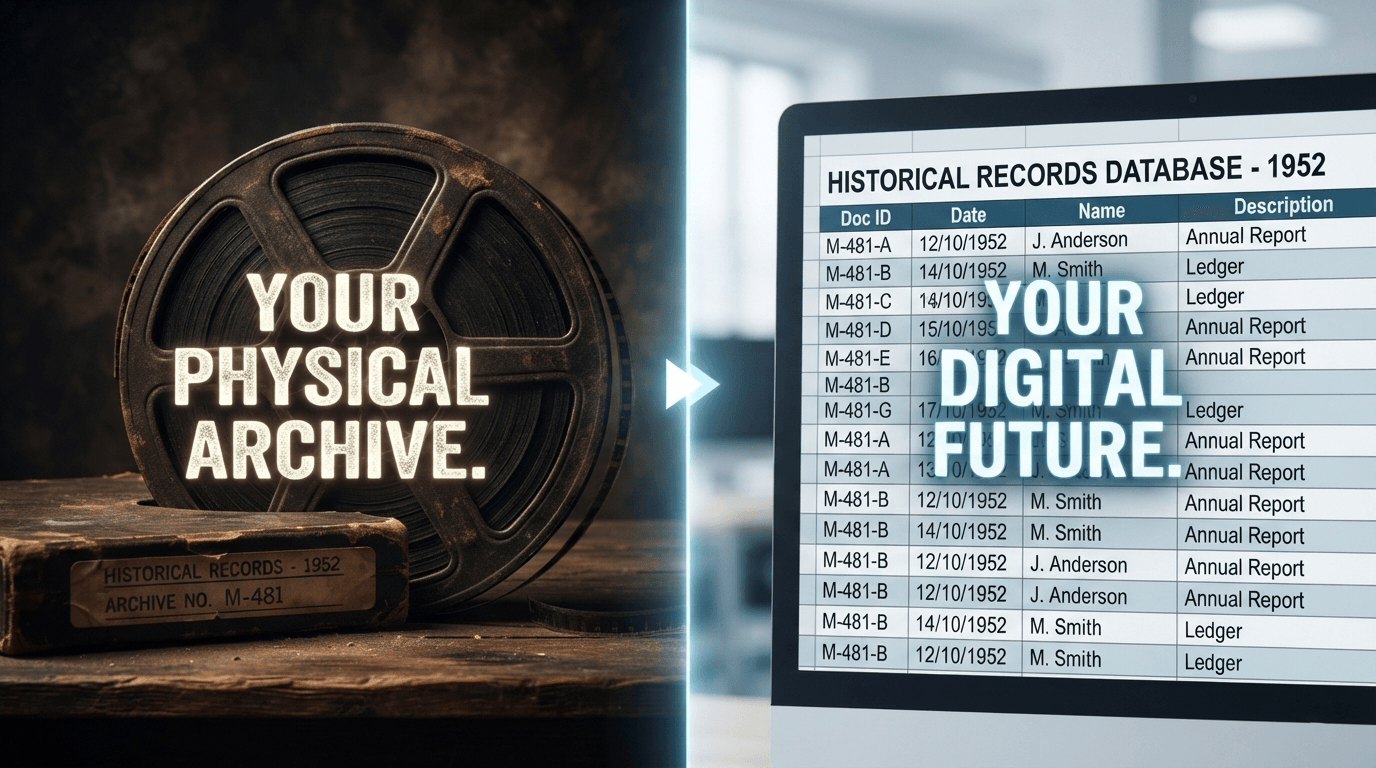
MICROFILM DIGITIZATION SERVICE

Preserve Your Archives Digitally

Transform fragile 16mm and 35mm reels into searchable, high-resolution digital assets. Unparalleled quality, archival precision.

Microfilm holds invaluable historical records but is increasingly fragile. At American Digital Memories, we eliminate the need for bulky reader machines by transforming your delicate film into crisp, legible digital files.

WE SPECIALIZE IN:

16mm & 35mm Expertise

High-resolution scanning of both 16mm and 35mm formats

Full OCR Searchability

Advanced OCR technology to make text searchable online or offline.

Secure Archival Handling

Secure handling protocols for historical and corporate archives.

Precision Engineering for Microfilm Digitization

From Quality to Care to Accuracy, our protocols ensure your microfilm archives are scanned without damage. Discover the exact steps we take to guarantee bit-perfect fidelity in every frame.

Quality
Care
Accuracy

"We employ a specialized digitization process designed to handle these delicate media with utmost care and precision."


See how we deliver on these promises through our 4-step workflow ↓

Your Microfilm Preserved with Four Pillars of Care.

From gentle handling to searchable indexing, we employ a specialized process designed to ensure your delicate media is handled with utmost precision and accuracy.

Assessment & Condition Reporting

We begin with a thorough assessment of each microfilm collection, noting film type (acetate or triacetate), condition, and potential signs of Vinegar Syndrome.

We provide detailed condition reports to clients before we even touch the reels.

Gentle Handling & Stabilization

Our trained technicians carefully handle each reel, employing specialized techniques to minimize stress on fragile film. We ensure your originals remain intact during the entire process.

High-Resolution Scanning (Mekel Mach10 Pro)

We utilize state-of-the-art Mekel Mach10 Pro scanners to capture high-resolution images that accurately reproduce the original content. We prioritize non-destructive scanning methods to preserve your archive.

Image Processing, QC & Indexing

Images are carefully processed to enhance readability and correct artifacts. Rigorous quality control ensures accuracy, while comprehensive metadata is created for easy searchability.

"Every step is designed to ensure your history remains accessible forever."

Our Specialized Detection of Vinegar Syndrome

We don't just clean microfilm...we detect the chemical signature of acetic acid before it destroys your data.

The Problem

Chemical Instability: Acetate degrades over time.

Precise Detection Before Touching Film


We utilize specialized equipment and techniques to accurately identify and quantify the presence of acetic acid. This provides a baseline data point for monitoring deterioration.


Non-Destructive Testing: We detect the chemical threat without risking damage to your fragile original reels.

Diagnose Vinegar Syndrome Before Digitization

"Having managed this specific risk, we are ready to deliver your microfilm with Care, Quality, and Accuracy as promised in our core process."

The Value of Digital Preservation

Moving from fragile cellulose to secure, accessible digital assets

Physical Safety & Longevity

Eliminates the risk of 'Vinegar Syndrome' and physical handling damage. Captures original colors before fading occurs.

Universal Accessibility

View instantly on any device without specialized equipment. Share family stories securely with researchers worldwide.

Precision & Indexing

Transforms static images into searchable data. Full OCR tagging and detailed project reports for easy retrieval.

Archival Quality & Versatility

Lossless TIFF/PDF/A output. We handle 16mm, 35mm reels, and complex schematics.

Why Preserve Microfilm Archives?

The Fragility of Film Archives: A Silent Crisis in the Making

Microfilm—specifically the ubiquitous 16mm and 35mm formats that dominated document storage from the mid-20th century to the digital age—revolutionized humanity's relationship with history. By shrinking thousands of pages of text onto a single roll, it promised an eternity of preservation, offering a solution to the space constraints of paper archives. However, what was once considered the gold standard of durability is now facing a silent, accelerating crisis. While microfilm offers a degree of protection against fire, water, and pests compared to original documents, it is far from immune to decay. As we transition toward digital preservation, understanding the unique vulnerabilities of our film collections becomes critical.

The Chemical Instability: The Enemy Within

The most insidious threat to microfilm lies not in external environmental factors like humidity or temperature fluctuations alone, but within the film itself. The base stock used in early microfilm production was primarily cellulose acetate (often labeled "Safety Film") or, in older collections, less stable cellulose triacetate.

Over time, the cellulose molecules begin to break down through a process known as oxidation. This chemical reaction releases acetic acid, which catalyzes further degradation of the film base. This phenomenon is universally recognized by archivists as "Vinegar Syndrome." It acts as a self-perpetuating cycle: the more the film degrades, the more acid it produces, leading to rapid deterioration if not caught early.

The Threat of Vinegar Syndrome: A Silent Killer

Vinegar Syndrome is deceptive because its symptoms often develop slowly over decades before becoming catastrophic. In the early stages, collectors may notice a faint, sour vinegar smell emanating from sealed boxes—a strong indicator that active chemical breakdown has begun. If ignored, this smell intensifies into a pungent stench that can permeate entire storage facilities, making them uninhabitable for staff and creating severe respiratory hazards.

As the condition worsens:

  • Brittleness: The film loses its flexibility and becomes increasingly fragile.
  • Image Loss: As the emulsion (the photographic layer) separates from the base, fine details blur, lines thicken, and eventually vanish entirely.
  • Disintegration: In advanced stages, the film can literally crumble into dust or shatter upon handling.

This "silent killer" poses a particular threat to collections produced before 1980, when manufacturers began shifting toward safer polymers like polyester (M-KOD). Even pre-1980s collections are vulnerable, and those from the 1960s and 70s remain at high risk. Once a roll suffers severe vinegar syndrome, there is virtually no way to salvage the images without specialized, expensive restoration techniques that are rarely available in standard archives.

Physical Damage: The Cumulative Toll

While chemical decay is often invisible until it's too late, physical damage to microfilm is immediate and permanent if not addressed promptly. Microfilms are incredibly thin—often thinner than a credit card—and this makes them susceptible to handling errors, environmental shifts, and improper storage practices.

  • Scratches and Scuffs: Because the images are microscopic relative to the film width, a single nick from a fingernail or a dust particle can permanently obliterate an entire line of text. Unlike digital files where you can crop out a bad section, physical scratches on microfilm destroy data that cannot be recovered.
  • Warping and Curl: Fluctuations in humidity levels cause the flexible plastic base to expand and contract unevenly. Over time, this leads to warping, curling, and buckling of the rolls. A warped reel not only becomes difficult to wind onto readers but can also cause mechanical damage when inserted into microfilm readers or scanners.
  • Mold Growth: In damp storage environments, mold spores can settle on the plastic base. While often harmless visually in small amounts, extensive mold growth accelerates chemical breakdown and releases toxic mycotoxins, threatening both the archive's integrity and the health of researchers.

The Consequence: Loss of Access

The ultimate tragedy of deteriorating microfilm is not just the destruction of the material itself, but the loss of access to vital information contained within. Whether it is genealogical records, census data, legal transcripts, or scientific research logs, these documents represent irreplaceable historical evidence.

When a collection begins to degrade:

  1. Research is Halted: Scholars and historians are unable to view the documents, stalling academic inquiry and community history projects.
  2. Data Divergence: As images blur over time, automated digitization becomes impossible without risking further damage during repeated scanning attempts. This creates a bottleneck where valuable data remains trapped in failing physical media.
  3. Cultural Memory Fades: For local histories and family legacies, the gradual fading of an image is as damaging as its total destruction. It signifies a loss of collective memory that cannot be undone once the film disintegrates.

Conclusion
The fragility of microfilm archives serves as a stark reminder that no physical format is eternal. While microfilm revolutionized storage in its time, it has evolved from a preservative miracle into a ticking time bomb for many institutions. The battle against Vinegar Syndrome and physical decay requires proactive management: rigorous monitoring of storage conditions, regular assessment of collection health, and strategic digitization to create robust digital surrogates before the film crumbles into history's dust.

Ready to Digitize Your Archives?

Schedule a free consultation to discuss your microfilm collection.