Book Digitization & Preservation

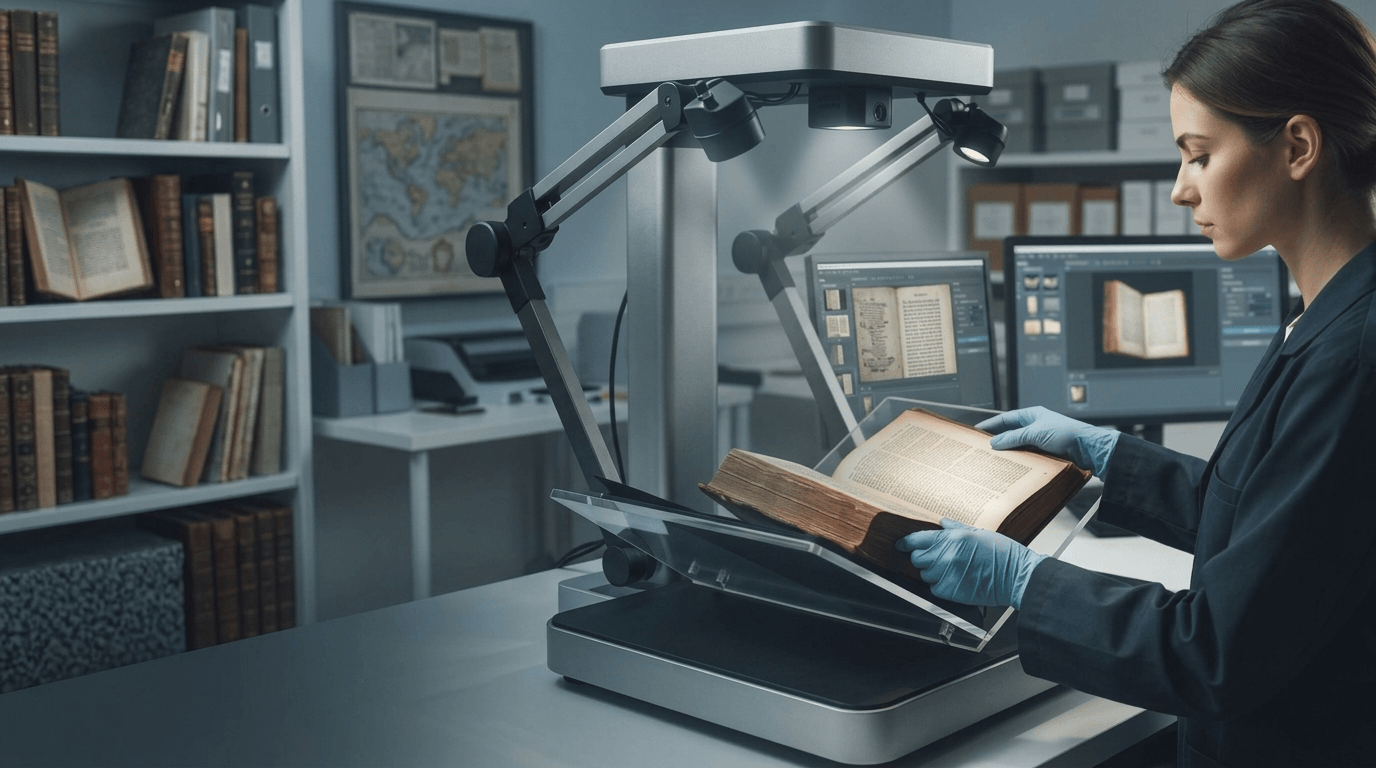
Safeguarding Written Heritage Without Disassembly. We offer non-destructive scanning for fragile and rare books using advanced overhead technology.

Preserve Your Library, Family History, or Rare Collection!

Our Secure Digitization Pipeline

From climate-controlled intake to delivery, your archives follow a secure chain of custody.

At American Digital Memories, we understand that many books are too fragile to remove from their bindings for standard scanning. In fact, attempting to disassemble a rare volume can cause irreversible damage to the glue and paper joints.

We specialize in Non-Destructive Scanning & OCR specifically calibrated for Books. Whether it is a cherished family cookbook, a crumbling legal code, or a historically significant text, our expert services allow you to create fully searchable digital archives while keeping your physical collection safe and intact.


Precision Assessment & Gentle Processing: Our 4-Step Workflow

Digitizing books requires a specialized workflow designed to minimize risk while maximizing quality. Here is how we handle your collection:

01

Thorough Condition Assessment

Before scanning begins, our team conducts a detailed inspection of each volume's paper type, binding strength, and signs of deterioration (worm damage, water spots, brittleness). We provide clients with detailed condition reports to manage expectations regarding what is safe to scan.

02

Non-Destructive Scanning Setup

Each book is mounted in a custom V-cradle or on a flatbed specific to its size and fragility. We utilize "touchless" techniques where the scanner utilizes overhead cameras to scan the pages, preventing further damage during the scan itself.

03

Image Processing & Correction

Once scanned, images undergo careful post-processing. We use state-of-the-art software to correct minor imperfections (scratches, shadows) and enhance contrast while maintaining the authentic look of the original text and bindings.

04

Indexing & Custom Taxonomy

Every digital object is meticulously indexed with precise file names created specifically for your collection. This ensures your book files are organized logically, allowing for instant discovery and easy retrieval within any personal archive or library software system.

Why Digitize Your Books? The ROI of Preservation

Protection from Physical Deterioration

By digitizing fragile books, you create a permanent digital backup before irreversible damage occurs due to humidity, light exposure, or natural aging.

Zero Handling Wear

Minimizes the need to open rare volumes repeatedly for reading or research, significantly reducing wear and tear on spines, endpapers, and loose pages.

Accessibility for Future Generations

Ensures that vital historical, legal, family recipes, or genealogical information remains accessible to researchers and loved ones forever, regardless of the physical book's condition.

Cost-Effective Long-Term Preservation

While there is an initial digitization investment, it eliminates the high recurring costs associated with professional archival storage (climate control, fire suppression) and insurance premiums for rare physical collections.

Why Preserve Books?

The Fragility of Knowledge

For centuries, books have been the cornerstones of our civilization – repositories of knowledge, art, history, and culture. They hold within their pages the voices of generations past, offering invaluable insights into human experience. But these treasures are inherently fragile. Time, environmental factors (light, humidity, temperature fluctuations), handling, pests, and even well-intentioned but improper storage can all contribute to irreversible deterioration.


The Silent Decay: Paper naturally degrades over time, becoming brittle and discolored. Leather bindings dry out and crack. Ink fades or bleeds. These processes are relentless and often accelerate unexpectedly. When a physical book begins to crumble, it is not merely the loss of an object; it is the erosion of a tangible connection to history that cannot be undone.


The Limits of Physical Preservation

While libraries and archives strive to save rare volumes through climate-controlled vaults and specialized conservation techniques, these methods are reactive and limited. A physical book can only exist in one specific location at a time. If a building burns down, if a flood strikes, or if an item is mishandled by a curious researcher, that unique artifact may be lost forever.


Furthermore, the very act of preserving a fragile original often creates paradoxes:

  • Restricted Access: To keep a book safe from further damage, it must remain locked away in climate-controlled storage, limiting its availability to researchers who desperately need to read or analyze it.
  • Irreplaceable Loss: Once a book is lost or significantly damaged, its contents are gone forever. We cannot recreate the original artifact with 100% accuracy. The specific paper stock of a book printed in 1850 cannot be perfectly replicated today; the marginalia of a handwritten letter cannot be recovered.

Digitization: The New Shield for Human History

This is where digitization emerges not just as a modern convenience, but as an essential strategy for preserving books against time itself. By converting physical books into high-resolution digital files, organizations and individuals can perform a critical "time travel" that ensures knowledge survives even if the physical vessel fails.

  1. The Digital Immortality of Knowledge

Digitization creates a permanent copy of the book's content. Unlike paper, which degrades chemically over decades, digital data—when properly stored on multiple redundant systems—can last for centuries or even millennia. If the original library building is destroyed by fire or natural disaster, the digitized version ensures that the text remains accessible to future generations. The physical copy may vanish, but the knowledge lives on in the cloud and local servers.

  1. Expanding Access Without Risk

Digital preservation solves the conflict between conservation and access. Libraries can now allow researchers to read, search, and analyze rare or fragile volumes without ever touching them. A student in a developing country can access a first edition of a classic from a top-tier archive in Europe through a digital viewer. This democratizes education, allowing the power of books to spread globally rather than remaining confined behind glass cases in climate-controlled rooms

  1. Enabling New Types of Research

Modern digitization goes beyond simple text extraction. Advanced imaging techniques allow researchers to see through layers of discoloration, revealing faded ink and under-drawn drafts. Optical Character Recognition (OCR) makes it possible for computers to search millions of words in seconds, uncovering patterns and connections that would take human librarians decades to find manually. This transforms a book from a static object into a dynamic source of data.

  1. Cost-Effective Long-Term Strateg

While the initial cost of digitization can be significant, it is often far less expensive than maintaining the physical condition of thousands of fragile books over a century. By investing in digital preservation now, organizations prevent future losses that could result from accidents or environmental damage. It acts as insurance for human heritage.


A Call to Action

The fragility of our written history demands action. Whether you are an individual collector, a school librarian, or a large research institution, the choice is clear: we cannot rely solely on the physical integrity of books to protect our collective memory.

Preserving books through digitization is an act of defiance against entropy. It ensures that the stories, lessons, and wisdom captured in ink remain alive for those who come after us. Let us secure our future by ensuring that no voice ever goes unheard because its home on paper eventually fell apart.

Let Us Preserve Your Written Heritage Today!

From library archives to personal family libraries, we are ready to digitize your books safely and efficiently.