Save the Sound of History:

Professional Audio Conversion & Restoration

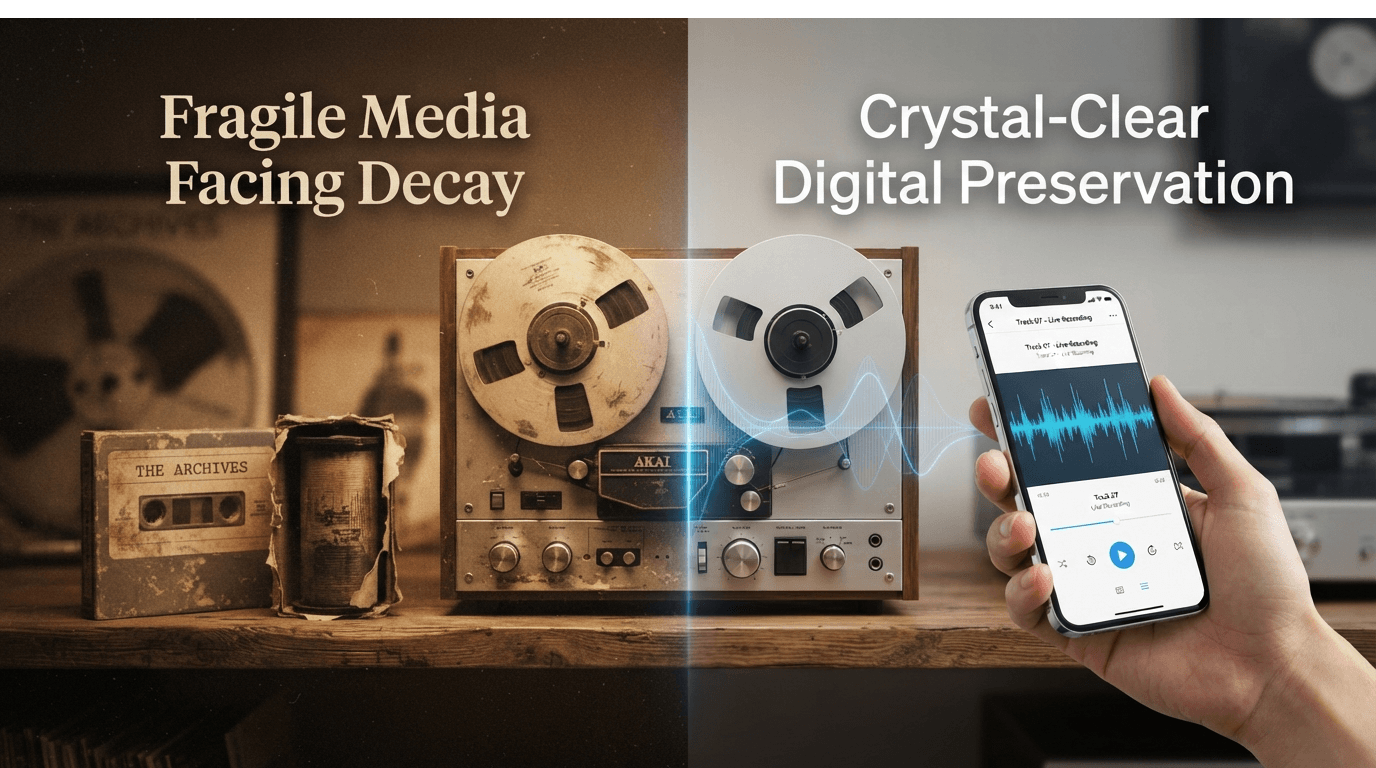
Analog recordings face a silent threat: magnetic decay and physical deterioration. At American Digital Memories, we specialize in converting fragile tapes, and records into crystal-clear digital files.

We ensure your family's stories, local history, and cultural treasures are preserved forever, accessible on any device without risking the original media.

"The 4 Pillars of Decay"

The Silent Threat: Understanding Your Collection's Vulnerability

Analog audio recordings hold irreplaceable value. They are tangible records of personal histories, cultural events, artistic creations, and significant moments that would otherwise be lost to time. However, these formats face a critical threat: degradation.

Magnetic Decay:

Magnetic tape degrades over time due to oxidation, binder breakdown, and demagnetization, resulting in audio dropouts, distortion, and signal loss known as "tape rot."

Physical Deterioration:

Vinyl records are susceptible to warping, cracking, mold growth (especially if stored in humid conditions), and physical damage from handling.

Equipment Obsolescence:

The high-end playback equipment required for these formats is becoming increasingly rare and unreliable. Many original players are broken or stop working soon.

Loss of Context:

Without proper preservation, the stories, laughter, and history contained in those recordings can vanish forever if the physical medium fails.

"Time is running out. Digitization stops this cycle of destruction immediately."

Precision Engineering for Every Format

We handle a wide range of audio formats with specialized equipment and deep expertise. We don't just play; we analyze, clean, stabilize, and digitize with surgical precision. Our workflow ensures that every recording is treated as unique art, preserving its integrity while delivering maximum fidelity to your digital files.

Step 1:

Condition Assessment & Documentation

Thorough physical inspection before any work begins.

Step 2:

Cleaning & Stabilization

Safe cleaning for tapes and records to prevent scratches.

Step 3:

Playback & High-Fidelity Digitization

Calibrated equipment capturing 24-bit/96kHz quality.

Step 4:

Noise Reduction & Restoration (Optional)

Software cleanup to remove hiss and pops while preserving authenticity.

Step 5:

Indexing & Metadata Creation

Creating searchable libraries with custom tags and dates.

We Handle It All – From Vintage to Rare Formats

Tape Reels & Cassettes

Reel-to-Reel: Professional 1/4" and 1/2" reels (various speeds like 7½, 15, 30 ips). We handle multi-track tapes common in radio archives and government records.

Cassettes: Standard Compact Cassettes, 8-Track Tapes, MiniDiscs, and Betamax/VHS audio tracks. Perfect for home movies and family interviews.

Vinyl & Acetate

Vinyl Albums

Shellac Records (33 & 78 RPM): The original format of jazz recordings and early speeches. These are brittle and require extreme care during playback to avoid cracking.


Why Digitize Your Analog Collection?

Choosing digitization is an investment in your family's history and your community's heritage. Here is why professional analog conversion is essential:

Protection from Physical Deterioration:

Creates a permanent digital backup before irreversible damage occurs. Once scanned, the original tape can be stored safely without being played.

Enhanced Accessibility:

Allows for easy listening on modern devices (phones, computers, tablets) with features like skipping tracks and volume control.

Improved Image/Audio Quality:

Digitization often improves clarity by removing static, hiss, and surface noise that makes old tapes sound rough or muddy.

Reduced Handling:

Minimizes wear and tear on fragile media. The fewer times you handle a vintage reel-to-reel, the longer it lasts.

Preservation of Cultural Heritage & Personal Memories:

Ensures that valuable recordings are preserved for future generations to hear and learn from.

Why Preserve Analog Audio?

In an era defined by the instantaneity of digital downloads and cloud storage, there exists a quiet, enduring counter-movement dedicated to the survival of analog audio. From the crackle of vinyl records to the warm, fuzzy resonance of reel-to-reel tapes, these physical mediums have carried humanity's music, memories, and voices for over a century. Yet, despite their nostalgic allure, they face an existential crisis.

Analog audio recordings hold irreplaceable value. They are tangible records of personal histories, cultural events, artistic creations, and significant moments that would otherwise be lost to time. However, these formats face a critical threat: degradation. Without active preservation efforts, we risk erasing the sonic fingerprints of our past.

The Silent Enemy of Magnetic Tape

One of the most common misconceptions about analog audio is that it lasts forever like a perfect digital file. In reality, magnetic tape is one of the most fragile media formats ever created. It suffers from magnetic decay over time due to oxidation and binder breakdown within the tape base.

As the adhesive holding the magnetic particles together deteriorates, the tape can become brittle or separate entirely. This leads to catastrophic audio failure, including sudden dropouts, severe distortion, and a complete loss of signal. Once those magnetic grains degrade beyond recognition, the information is gone forever. Without regular archiving and playback cycles that refresh the magnetic field, these recordings slowly crumble into noise.

The Physical Vulnerability of Vinyl

While tape threatens to lose its data silently in the canister, other formats like records and cylinders face immediate physical danger. These are heavy, brittle objects susceptible to warping when exposed to humidity changes, cracking from temperature fluctuations, and mold growth if stored in poor conditions. Furthermore, they rely on careful handling; a drop or a slip of the needle can permanently damage the lacquer master or the groove structure itself. Unlike a digital backup where you can copy data infinitely without loss, a physical record exists as a single point of failure. If that one vinyl copy degrades, the unique texture and history embedded in those grooves vanish.

The Vanishing Playback Equipment

Beyond the media itself, there is the issue of equipment obsolescence. As manufacturers phase out production lines for older formats, specialized playback gear becomes increasingly rare and unreliable. Finding a working reel-to-reel machine or a vintage turntable that can play fragile recordings with precision is becoming difficult, and maintaining these machines requires expertise that is fading from public memory.

When the equipment dies alongside the physical media, we risk creating "silent archives"—collections of records and tapes that cannot be played by anyone but perhaps one curious collector who happens to find a compatible machine in their basement.

The Irreplaceable Context

Perhaps the most profound threat is not technical, but historical: Loss of Context. Analog recordings are often tied to specific locations, times, people, and stories. A recording made in a specific house in 1950 carries the atmosphere, acoustics, and emotional weight of that moment.

Without proper preservation—digitizing these files with high fidelity and cataloging them with their metadata—the stories surrounding the recordings can be lost forever. We risk reducing rich cultural narratives to mere filenames on a server that might one day become corrupted or inaccessible. The context that gives audio its meaning evaporates if we do not actively capture and protect it now.

Preserving Our Sound

The preservation of analog audio is not just about nostalgia; it is an act of historical stewardship. By digitizing magnetic tapes, wrapping records in acid-free sleeves, managing humidity levels, and archiving equipment, we ensure that future generations can still listen to the voices, music, and stories that shaped our world. The crackle of the tape and the pop of the vinyl are not just artifacts; they are vital pieces of our collective memory that must be saved before silence takes over.

Ready to Bring Your Voice Back to Life?

Whether it's a single family interview or a decade of local history, we provide the care and expertise needed to digitize your analog collection safely. Get started today.