Background

Professional Document Digitization & Archiving

From Letters to Records: We Create Searchable Archives That Mirror Your Physical Collection.

Preserve Your Correspondence and Vital Records!

At American Digital Memories, we offer comprehensive Non-Destructive Scanning & OCR for documents ranging from organizational correspondence to vital government records, court filings, and land deeds. Our services are tailored to handle various paper formats, weights, and ages without risking damage.

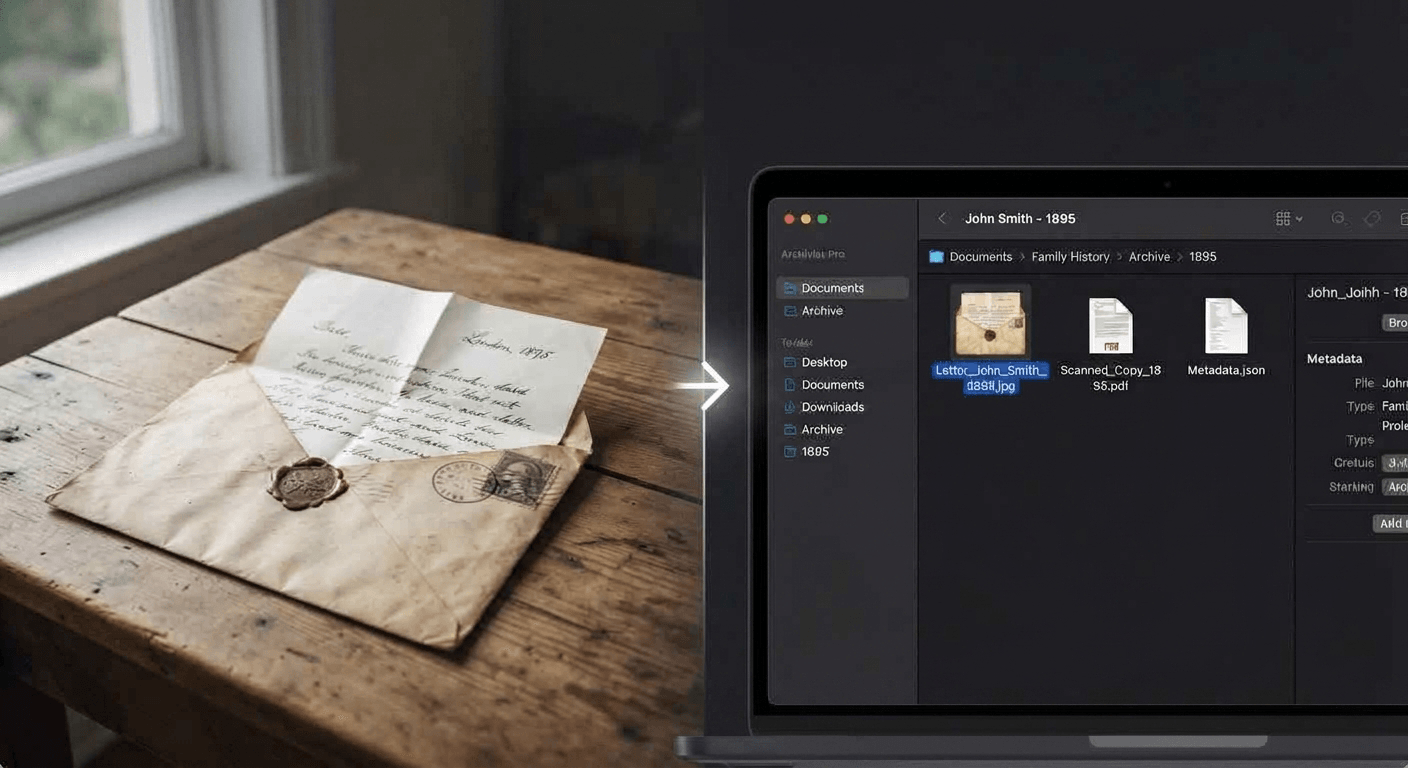
Unlike generic scanning services that simply dump files into a list, we pride ourselves on Contextual Archiving. We scan the contents of your paper documents and organize our digital archives so they perfectly match your physical presentation. This ensures that when you search for a specific record, it is always found alongside its original wrapper in our system, preserving the historical context and order of your collection.

Our Document Digitization Services Include:

Non-Destructive Scanning

Gentle scanning techniques suitable for loose papers, microforms, and varied paper types without damaging the original document.

Advanced OCR (Optical Character Recognition)

Unlock the full potential of your hard-to-read documents with searchable digital text layers. Our engine is tuned to handle handwritten script, faded ink, cross-outs, and complex layouts found in legal or genealogical records.

Contextual Organization

We preserve the context by organizing our digital files alongside their original envelopes, maintaining the exact order and presentation of your collection for easy reference.


Careful Cleaning & High-Resolution Capture: Our 4-Step Workflow

From assessment to indexing: The exact steps we take to transform loose papers into pristine, searchable digital assets.

01

Assessment & Condition Reporting

We begin with a thorough assessment of each document collection, noting paper type (acid-free vs. degraded), condition, and any signs of mold or deterioration. Detailed reports for degraded items are provided to clients before work begins so you know exactly what is being handled.

02

Surface Cleaning (Case-by-Case)

For documents covered in loose debris, dust, or surface contaminants that could scratch the scanner glass, we employ gentle cleaning techniques. This is done strictly on a case-by-case basis using non-destructive methods to ensure safe removal of contaminants without harming the paper.

04

Post Processing & Indexing

Our "Crop, Deskew, & Index" workflow ensures every digital file is perfectly aligned and sized (e.g., Letter size or Legal size). We then index and custom-name your files (e.g., Smith_John_1920_Letter.pdf) to make your archive instantly searchable and logically organized within any software.

03

High-Resolution Scanning

Utilizing state-of-the-art flatbed scanners with varying resolution settings (up to 600dpi+), we capture images that accurately reproduce the original content. We adjust focus, lighting, and corner rounding based on the document's opacity and text clarity for a museum-quality result.

The Value of Document Digital Preservation

From permanent backups to reduced handling: The tangible advantages of converting fragile paper collections into safe digital archives

Permanent Backup

Creates a safe, geo-redundant digital copy before irreversible damage occurs from humidity, pests (bookworms/mice), fire, or natural aging of paper fibers.

Reduced Handling & Wear

Minimizes the physical handling required to read letters or records over decades. By reading on a screen rather than holding fragile originals, you protect them from further deterioration.

Preservation of Historical Context

With our contextual archiving service, you never lose the relationship between a document and its wrapper. The digital archive mirrors your physical timeline perfectly; every file is organized to match the original envelope order, ensuring you can instantly locate any document in its proper place within your history.

Long-Term Cost Efficiency

While digitization requires an upfront investment, it provides a significantly cheaper alternative to ongoing professional archival storage costs (climate control, fire suppression systems) and restoration fees over decades.

Why Preserve Documents?

The Imperative of Protecting Our Written History

In an age where information flows freely through emails, cloud storage, and social media, there exists a quiet crisis that often goes unnoticed: the erosion of our physical records. While digital data is ubiquitous, it is not immune to failure, nor does it capture the tangible history of human experience quite like paper does. Documents—from handwritten letters and legal contracts to historical maps and vital records—are essential for understanding our past and managing our present. They provide invaluable insights into individuals, organizations, events, and societal evolution.

However, preserving these documents is not merely an act of nostalgia or bureaucratic duty; it is a critical necessity. The very nature of paper makes it vulnerable, and the cost of ignoring this vulnerability can be measured in lost history, unresolved legal disputes, and broken chains of accountability. Here is why we must protect our physical records before they fade into oblivion.


The Fragility of Paper Records: A Chemical Reality

While paper has long been considered a durable medium for information storage, the science behind its longevity reveals that it is inherently fragile. We often assume that ink on paper lasts forever, but in reality, paper is a chemical reaction between wood pulp or rag fibers and binding agents that eventually breaks down over time.

Natural Degradation

Paper naturally degrades over time due to acid content, light exposure, humidity fluctuations, and environmental pollutants. This process is known as acid hydrolysis. In the late 1800s and early 20th century, most paper was made from wood pulp containing lignin (a substance that makes paper strong initially but brittle over time). As lignin oxidizes, it turns yellow and causes fibers to break down.

  • Light Exposure: Ultraviolet (UV) light accelerates this breakdown, fading inks and bleaching the paper surface.
  • Humidity Fluctuations: Paper is hygroscopic, meaning it absorbs water vapor from the air. If humidity fluctuates between high and low levels, it causes fibers to expand and contract repeatedly. This "breathing" weakens the structural integrity of the document until it becomes brittle or crumbles into dust (a condition known as brittle decay).
  • Pollutants: Indoor pollutants like sulfur dioxide and nitrogen oxides can react with the paper, causing staining and further acidification.

Physical Damage: The Silent Destroyers

Beyond chemical changes, physical damage poses an immediate threat to document survival. A single mishandling event can compromise the integrity of a century-old record.

  • Handling: Every time a document is touched, oils from human skin are transferred to the surface. Over decades, this buildup can cause discoloration and weaken the fibers.
  • Pests: Insects such as silverfish, bookworms (dermatitis), and termites feed on paper or glue used in bindings. In extreme cases, pest infestations have been known to consume entire archives.
  • Disasters: Water damage is perhaps the most devastating physical threat. Even a small leak from a pipe can cause permanent warping, mold growth (which eats at the fibers), and ink running. Fire remains the primary historical destroyer of records; in 2016 alone, over $4 million worth of records were lost or damaged due to water/fire incidents in various institutions globally.

Loss & Destruction

Even if a document is kept in an ideal climate, it can be lost through human error or deliberate acts. Records are often lost or destroyed through carelessness (e.g., misfiling during a move), natural disasters like earthquakes that crush storage buildings, or deliberate acts such as burning or destruction during periods of conflict and regime change.

Limited Accessibility: The Consequence of Neglect

The most critical consequence of document degradation is limited accessibility. If documents deteriorate to the point where they are unreadable—such as when paper turns to dust—the information contained within it effectively ceases to exist. This poses a severe risk for three main areas:

  1. Research: Historians and genealogists rely on primary sources. If a land deed crumbles or a birth certificate is lost, historical narratives become inaccurate or incomplete.
  2. Legal Proceedings: Courts must adhere to the principle of "truth through evidence." Without preserved documents regarding contracts, deeds, or treaties, legal disputes over property boundaries can drag on indefinitely, preventing justice from being served.
  3. Historical Understanding: Societal evolution is often traced through records like census data and voting rolls. If these are lost, we cannot accurately measure the impact of laws, demographics, or political movements on specific groups.

Conclusion: A Shared Responsibility

The fragility of paper records is not a flaw in the technology but a challenge to our preservation practices. From natural acid degradation to physical threats from pests and disasters, documents are under constant siege. However, this vulnerability highlights the urgency of preservation efforts.

Preservation ensures that we do not lose our proof of existence, legal rights, or cultural heritage. By understanding the risks associated with Natural Degradation, Physical Damage, and Loss, institutions and individuals alike can take proactive steps—such as digitization, proper storage conditions (acid-free containers), and climate control—to ensure these documents survive for future generations to use. We preserve not just paper, but truth.

Let Us Preserve Your Paper History Today

From genealogy projects to legal archives, we turn fragile paper into permanent digital assets.